
Paulding Projected Versus Actual Release
A projected date is a calculation or legal milestone based on facts known at the time. An actual release date records when a custodian processed the person out. They can differ. Credits, a new court order, discipline, an unresolved hold, a transfer, judicial release, or a Parole Board action may change the expected path. The Paulding County Jail’s operational release entry is the best source for the physical county-jail exit. A court journal shows legal authority, while ODRC shows the state-prison status and its sentence fields.
Pretrial custody is different. A bond amount or recognizance order can make release possible, but it does not supply a guaranteed exit time. The bond must be posted when required, the jail must receive and process the authority, and every other hold must be cleared. A transfer to ODRC, another jail, federal custody, or ICE ends one custodian’s control but is not a community release.
Paulding ODRC Dual Date Label
The ODRC Offender Search uses the exact label “Expected Release Date/Parole Eligibility Date.” The slash is meaningful. For a definite prison term, the field may reflect a projected expiration after jail-time credit and applicable earned credit. For an old-law or life sentence, it may instead show the first date on which parole can be considered. Eligibility gives the Board authority to consider release. It is not a grant of parole.
Open the full record and read that field with Status, Aggregate Sentence, Jail Time Credit, Admission Date, release detail, and the Next Parole Board Hearing/Review Month. “POA Date” means parole on or after, which is the earliest date for release on APA supervision under the applicable decision. “PRD” means projected release date. An Earliest Possible Transfer Date can refer to transitional control, not an unconditional exit.
The official ODRC status and date definitions explain these fields.
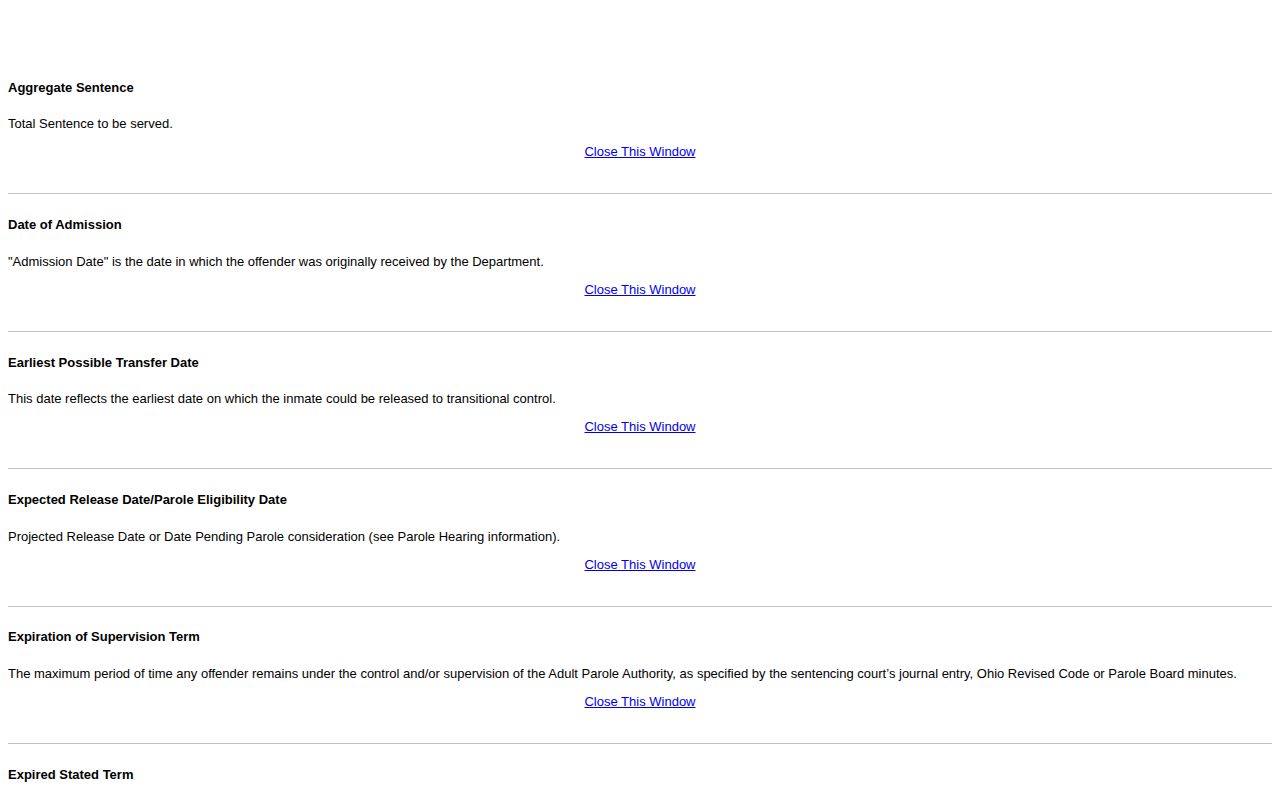
The definitions show why one date must not be copied without its label, status, and sentence context.
Note: ODRC warns that its sentence display may be incomplete, so compare the committing-court journal when a component seems missing.
Find a Paulding Projected Release Date
Start with the present custodian. A short Paulding County Jail sentence may never create an ODRC record. A state prison commitment must be searched statewide because no ODRC prison is located in Paulding County and people committed here can be housed at many institutions. Federal and immigration custody require their own locators. One silent database does not settle another agency’s status. The Paulding County released inmate search maps those custody-specific routes when the holding authority is uncertain.
- Match the person to a case. Use the full name, booking or ODRC number, date of birth, committing county, docket, and offense when those fields are available.
- For an Ohio prison term, search ODRC by name or number. Select Paulding under County of Commitment when the sentence arose in Paulding County.
- Open the detail and read the combined expected-release/parole-eligibility label with the status, aggregate term, jail-time credit, hearing month, and parole or release detail.
- For a county jail sentence, obtain the sentencing journal from Municipal Court or Common Pleas. Ask the jail for its existing sentence calculation or release entry.
- Check for another hold, consecutive term, transport order, or receiving agency. A move out of the Paulding jail may be a transfer.
- Near the anticipated date, confirm with the current custodian. After release, request the actual date, time, disposition, and destination if kept.
The official Paulding example at ODRC record A742433 shows the combined field and a future review in an incarcerated record.
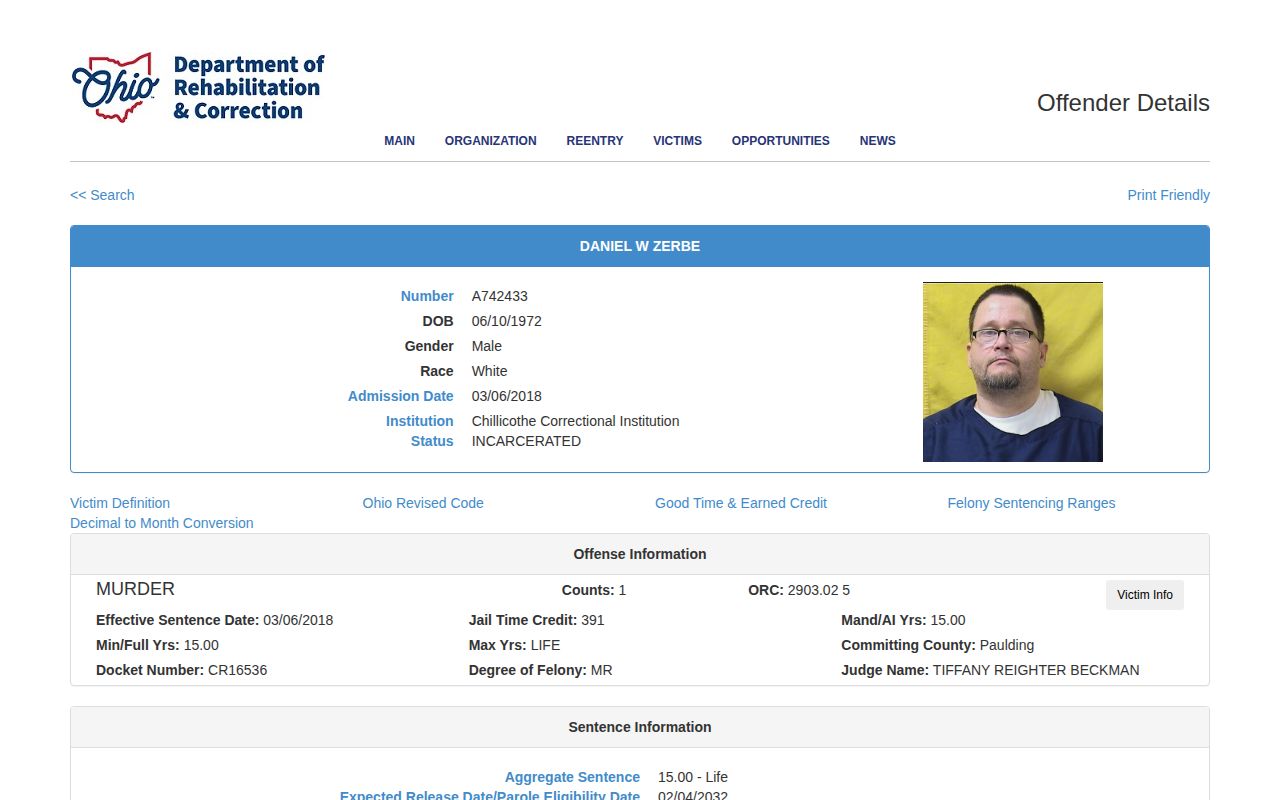
The example keeps the projected milestone beside hearing information, which prevents a future review date from being mistaken for completed release.
Paulding Jail Release Calculations
County jail dates come from the court’s sentence and the jail’s execution of that sentence. A journal may state imposed days, credit for time already served, and whether terms run at the same time or one after another. “Concurrent” means terms run together. “Consecutive” means one follows another. Later sanctions, stays, transport orders, or holds can alter a simple hand calculation. Ask for the controlling journal and the jail’s existing calculation rather than supplying a date based only on the charge or an online hold line.
No authoritative Paulding County jail good-time formula or weekend-release policy was found. ODRC’s prison earned-credit rules must not be applied to a local jail term by assumption. The immediate operational contact is the Paulding County Jail at 419-399-2170. The Sheriff’s Office is at 500 E. Perry St., Paulding, OH 45879, and its main records contact number is 419-399-3791.
A narrow request can ask for the existing jail sentence calculation, admission time, actual release date and time, disposition code, and destination or receiving agency if transferred. Under the sheriff’s records policy, the office need not create a new answer. Describe the person, booking, and date range so the custodian can identify an existing record.
Paulding Release Dates and Credits
Ohio’s current earned-credit framework is more precise than the common claim that every prisoner serves 85 percent. ORC 2967.194 applies to qualifying confinement on and after April 4, 2024. A qualifying person may provisionally earn one or five days for each completed month of productive participation, plus specified awards for completing certain programs. Ordinary participation and completion credit under division (A) is capped at 15 percent of the stated prison term. Other completion provisions can work separately.
That cap does not create a universal minimum-service formula. The statute excludes many terms and offenses. Credit may be denied or withdrawn for rule violations. Historical ORC 2967.193 governs qualifying time before the current effective date and used a different ordinary cap. Life or parole-eligible terms, mandatory or non-reducible time, jail-time credit, judicial release, and indefinite sentences also change the analysis. The individual record and sentencing law control.
Ohio’s administrative rules add another reason to avoid a quick percentage calculation. OAC 5120-2-06 implements earned credit, while OAC 5120-2-03.2 addresses sentence computation for covered terms. The agency must identify which sentence regime applies, what time qualifies, and whether an award was earned or later withdrawn. A court’s jail-time-credit entry can also shift the calculation because it recognizes days already spent in custody. That credit is not the same as credit earned through prison programs.
The captured current earned-credit statute sets out the qualifying activities, exclusions, caps, and withdrawal rules.
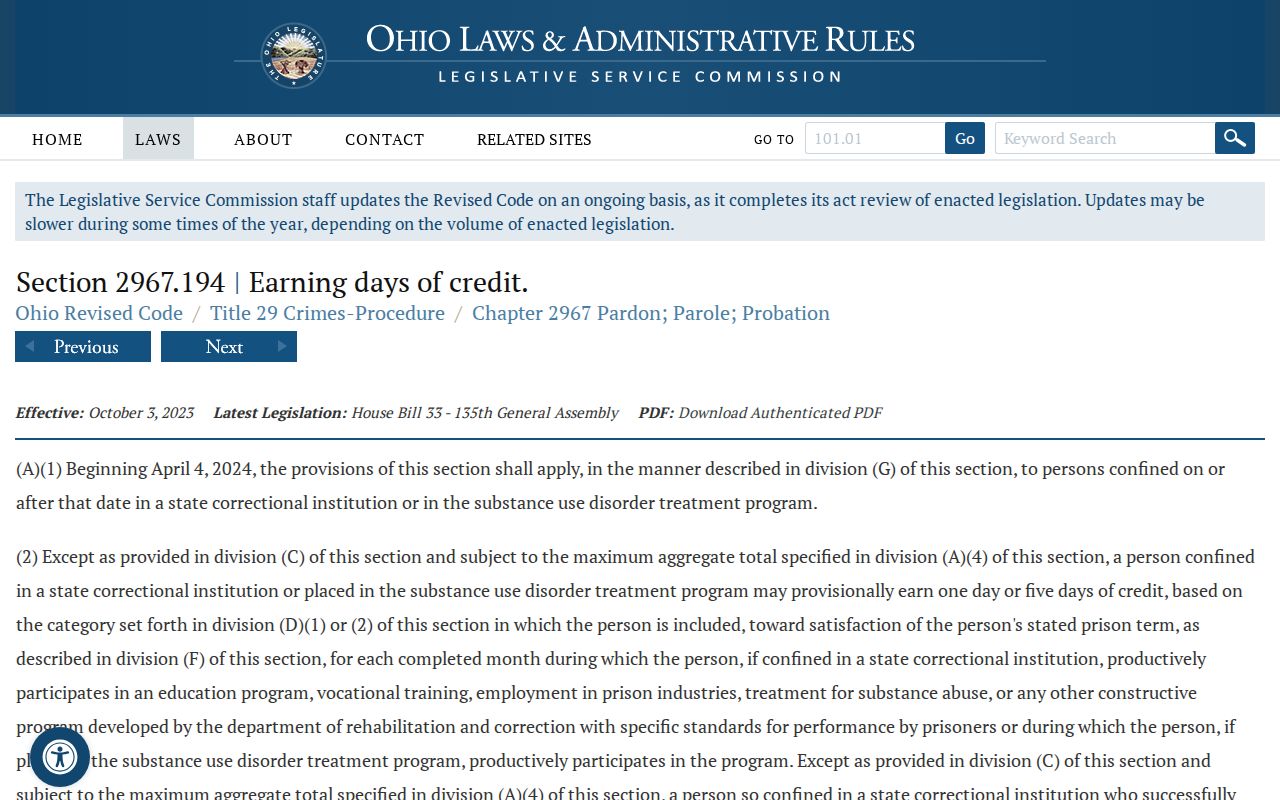
The statute supports a case-specific calculation, not a fixed percentage promise for every Paulding County commitment.
Paulding Indefinite Release Terms
Covered non-life indefinite sentences under Ohio’s Reagan Tokes framework have a minimum and maximum term. ORC 2967.271 creates a rebuttable presumption of release at the minimum, but ODRC can conduct a hearing and make required findings that support continued confinement. Any continuation cannot run beyond the maximum term. The minimum is therefore a key milestone, not an unconditional release guarantee.
Parole-eligible terms work differently. ORC 2967.13 governs eligibility for specified terms. A hearing may occur before the date displayed because the Board must decide in time to act. The individual result can continue the case, recommend parole, deny a transitional-control review, or report another type of proceeding. Preserve the exact result instead of reducing every Board action to “approved” or “denied.”
Transitional control adds another date. Under ORC 2967.26, an eligible person may move to community confinement, an approved residence, or electronic monitoring up to 180 days before expiration or parole. This is still Department control. It should not be described as final sentence discharge or ordinary Paulding County probation.
Why Paulding Release Dates Change
A date can move for lawful reasons even when the portal is working correctly. Compare the newest ODRC detail, the court journal, and the current custodian’s record before treating a mismatch as an error.
| Factor | Possible effect | Record to check |
|---|---|---|
| Jail-time credit | Credits court-recognized local custody toward the prison or jail term | Sentencing journal and ODRC sentence detail |
| Earned credit | May reduce qualifying prison time; denial or withdrawal can restore time | ODRC calculation and ORC 2967.194 |
| Court action | Judicial release, correction, stay, or a later sentence order may alter the path | Common Pleas or Municipal journal |
| Parole Board action | Can set, continue, or affect release for an eligible term | Individual ODRC result and public Board determination |
| Indefinite-term hearing | May support confinement past the presumptive minimum, up to the maximum | ODRC record, hearing finding, and statute |
| Detainer or hold | May cause transfer to another authority instead of community release | Jail release destination and receiving-agency record |
| Consecutive term | Adds time because one sentence follows another | Complete sentencing entries and aggregate term |
ODRC’s status qualifier also matters. “APA SUPERVISION” means release from prison into Department supervision. “RELEASED - Judicial Release” identifies a court-ordered route. “RELEASED - Death” plainly does not mean a return to the community. A transfer record identifies the next custodian and prevents a false report of freedom.
Note: A later date is not proof of misconduct; sentence law, another term, or a corrected record may also explain the change.
Confirm Paulding County Release Dates
Use a future date to plan a final check, not to announce an exit. For a state prisoner, reopen the ODRC detail and compare the status, expected-release/parole-eligibility field, review result, and release detail. For a county detainee, call the jail and then obtain the release entry. The court docket should confirm the legal order, but the order time may precede the moment corrections finishes release processing.
Ohio VINE can add a prospective status alert for a matching participating county or ODRC record. Register while the person is in custody when possible, choose the correct reporting agency, and treat General Release, Transfer, Escape, and Death as distinct events. The VINELink Check explains person matching and notification limits. An alert is corroboration, not a permanent release archive or proof of final destination.
When timing matters, ask for the source record after the event. For Paulding County Jail, request the actual release date and time, disposition, and destination if maintained. For ODRC, use the release detail and a precise public record request when needed. A past date plus a released qualifier is stronger than a future estimate, yet every label remains limited to the custodian that issued it.
Use the correct Paulding court when checking the legal basis. Municipal Court covers countywide misdemeanors and traffic matters. Common Pleas holds felony sentences and judicial-release orders. A Municipal record may show the first stage of a felony case, but it is not the final sentencing source. Save the journal entry and compare its case number with the ODRC detail. If the court order is new, allow for the court’s stated online posting lag and seek verified information directly. The jail’s execution record still supplies the physical exit time.